AI Productization: How ML Engineers Deploy AI Models into Real-World Products
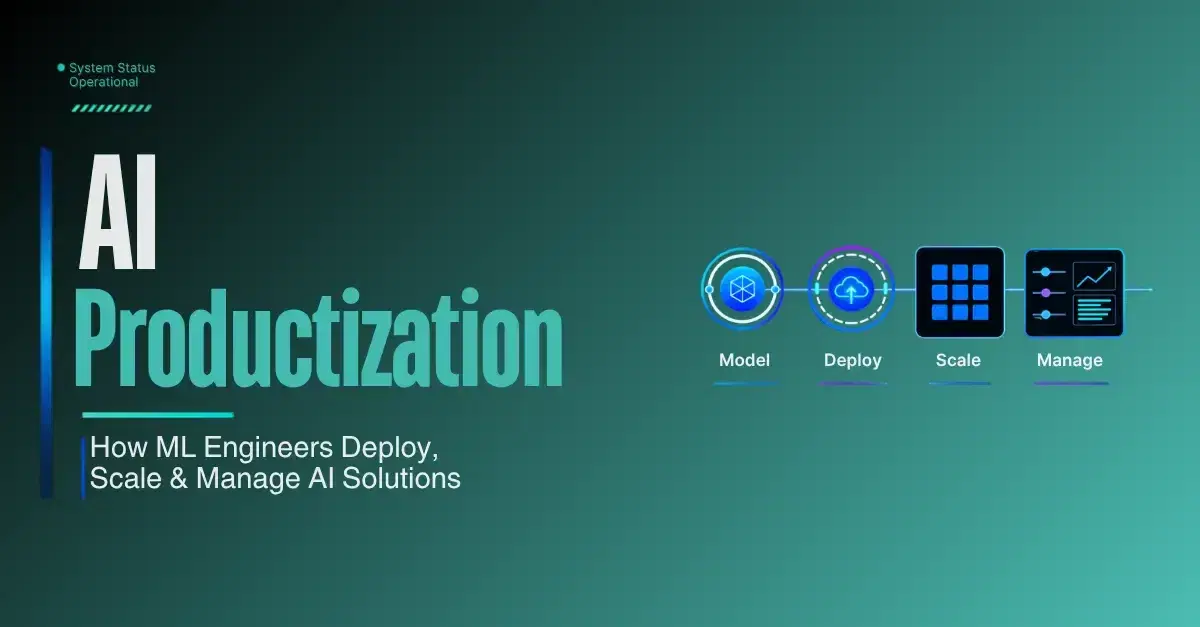
Artificial intelligence has moved beyond research labs and experimental projects. Today, organizations are focused on turning machine learning models into business-ready products that deliver measurable value. This process, known as AI productization, is transforming how ML engineers deploy, manage, and scale AI solutions.
While building an accurate model is important, it is only one step in the journey. The real challenge lies in deploying AI systems that are reliable, secure, scalable, and capable of supporting real-world users and business objectives.
What Is AI Productization?
AI productization is the process of transforming a machine learning model from a prototype into a production-grade solution that can be integrated into business applications, workflows, and customer experiences.
It involves:
- Model deployment
- Infrastructure management
- Data pipelines
- Monitoring and maintenance
- Security and compliance
- Continuous improvement and retraining
The goal is to ensure AI systems create consistent business value while maintaining performance and reliability.
Why AI Productization Matters
Many organizations successfully develop machine learning models but struggle to move them into production. A proof of concept may perform well in testing environments, yet fail when exposed to real-world data, higher traffic, or changing business requirements.
AI productization helps organizations:
- Reduce deployment risks
- Accelerate time-to-market
- Improve model reliability
- Scale AI applications efficiently
- Generate measurable business outcomes
- Maintain regulatory compliance
Without a structured productization strategy, even the most advanced AI models may never reach their full potential.
The Role of ML Engineers in AI Deployment
Machine Learning Engineers play a critical role in bridging the gap between data science and software engineering.
Their responsibilities include:
Model Packaging
ML engineers prepare trained models for deployment by converting them into formats that can be integrated with production systems.
Infrastructure Design
They select and configure cloud platforms, containers, APIs, and serving frameworks that support scalable AI applications.
Automation
Automation is essential for managing deployments efficiently. ML engineers use CI/CD pipelines, Infrastructure as Code (IaC), and orchestration tools to streamline releases.
Performance Monitoring
Once deployed, AI models require continuous monitoring to track:
- Prediction accuracy
- Latency
- Resource utilization
- Data drift
- Model drift
Monitoring helps teams identify issues before they impact users.
Key Stages of AI Productization
1. Model Development
The journey begins with data collection, preprocessing, feature engineering, training, and validation.
At this stage, teams focus on model performance metrics such as:
- Accuracy
- Precision
- Recall
- F1 Score
2. Model Validation
Before deployment, models must be tested using real-world scenarios and business requirements.
Validation includes:
- Stress testing
- Bias detection
- Security assessments
- Explainability checks
- Regulatory compliance reviews
3. Deployment
Deployment allows applications to access AI capabilities in production environments.
Common deployment methods include:
- REST APIs
- Microservices
- Edge deployment
- Batch processing
- Real-time inference platforms
4. Monitoring and Governance
Production AI systems need ongoing oversight.
Organizations monitor:
- Performance degradation
- Data quality issues
- User behavior patterns
- Security threats
- Compliance requirements
5. Continuous Improvement
AI products evolve over time. ML engineers regularly retrain models using fresh data to maintain accuracy and relevance.
This creates a continuous feedback loop that strengthens AI performance.
Technologies Enabling AI Productization
Several technologies support modern AI deployment workflows.
MLOps Platforms
MLOps helps automate the machine learning lifecycle, including:
- Experiment tracking
- Version control
- Deployment automation
- Monitoring
Containerization
Technologies like Docker package AI applications into portable environments, ensuring consistency across development, testing, and production.
Kubernetes
Kubernetes helps organizations manage and scale AI workloads efficiently across cloud environments.
Cloud Platforms
Major cloud providers offer managed AI infrastructure that simplifies deployment, monitoring, and scaling.
Benefits include:
- Elastic scaling
- High availability
- Simplified maintenance
- Reduced operational overhead
Common AI Productization Challenges
Despite its benefits, AI productization comes with several challenges.
Data Drift
Production data may differ from training data, causing prediction accuracy to decline over time.
Scalability Issues
Growing user demand requires systems that can handle increased workloads without sacrificing performance.
Security Risks
AI systems must protect sensitive data while preventing unauthorized access and adversarial attacks.
Model Maintenance
Models require regular updates, retraining, and validation to remain effective.
Organizations that address these challenges early establish a stronger foundation for long-term AI success.
Best Practices for ML Engineers Deploying AI Solutions
To maximize deployment success, ML engineers should:
- Design for scalability from the beginning
- Automate deployment pipelines
- Implement robust monitoring systems
- Track model and data versions
- Prioritize security and compliance
- Establish retraining workflows
- Collaborate closely with business stakeholders
These practices help ensure AI solutions remain reliable, adaptable, and aligned with business goals.
The Future of AI Productization
As AI adoption continues to grow, organizations increasingly recognize that model development alone is not enough. Success depends on the ability to operationalize AI efficiently and at scale.
Advancements in MLOps, automation, cloud-native architectures, and AI governance are making productization faster and more accessible. ML engineers will continue to play a critical role in delivering production-ready AI systems that drive innovation and competitive advantage.
Conclusion
AI productization is the key to transforming machine learning models into valuable business assets. By focusing on deployment, monitoring, scalability, and continuous improvement, ML engineers can ensure AI solutions perform effectively in real-world environments.
Organizations that invest in strong AI productization practices can accelerate innovation, improve operational efficiency, and unlock greater returns from their AI initiatives.


