The Rise of AI Productization: Why Businesses Need ML Engineers Who Can Deploy Models (Not Just Build Them)
Over the past few years, companies in the U.S. have gone from “testing AI ideas” to actually launching real AI‑powered products. Because of this shift, businesses no longer need only data scientists who can create models — they now urgently need machine learning engineers who know how to deploy these models into real‑world systems.
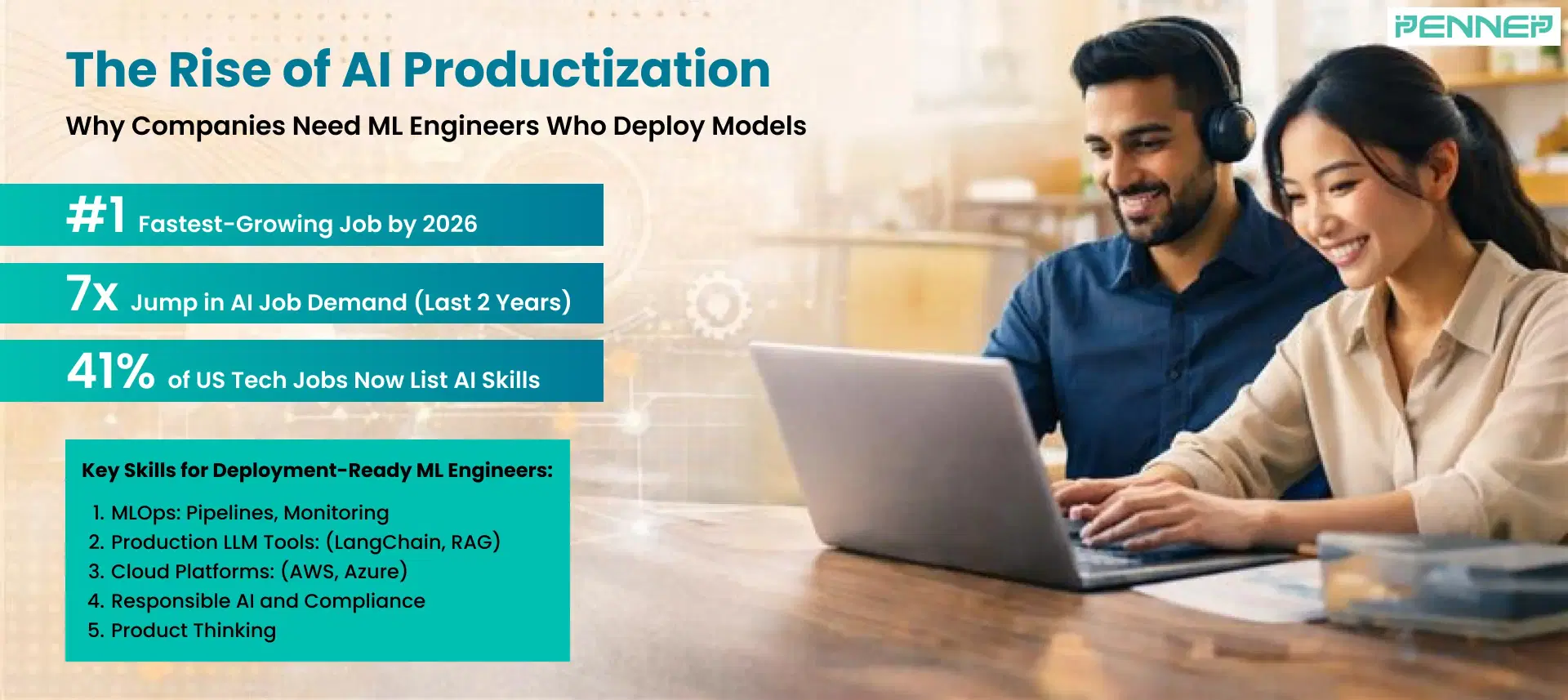
This change is showing up clearly in hiring trends. LinkedIn’s report on fast‑growing jobs for 2026 lists AI Engineers as the #1 fastest‑growing role in the entire country.
Another industry report shows that demand for AI‑related jobs has increased about seven times in just two years, and around 41% of U.S. tech job ads now mention AI skills.
In simple words: Companies don’t just need people who can “make” models — they need people who can actually “run” them.
What’s Changing?
AI is becoming a product, not just a demo.
In the past, many companies experimented with small proof‑of‑concept AI projects. But now, businesses want these models to:
- Work 24/7
- Handle thousands of users
- Fit into existing apps
- Stay accurate over time
- Stay compliant with data rules
- Deliver real business results
This requires a very different skill set — one focused on deployment, monitoring, and long‑term performance.
What Makes a “Deployment‑Ready” ML Engineer?
Today’s ML engineers need practical, hands‑on experience. Employers are now looking for skills like:
1. MLOps (Machine Learning Operations)
This includes building pipelines, automating updates, checking for model drift, and monitoring performance. These skills are now considered essential.
2. Production LLM Tools (like LangChain and RAG)
Many job postings now ask for experience with LangChain and RAG because companies want to build AI apps that can use their own data safely and reliably.
3. Cloud and Infrastructure Knowledge
AI apps run on cloud platforms like AWS or Azure, and companies need engineers who can manage compute power, costs, and system uptime. Tech hiring insights show cloud roles are still in strong demand.
4. Responsible AI and Compliance
Especially in industries like healthcare and finance, businesses want engineers who understand safety, privacy, and risk rules.
5. Product Thinking
Companies want ML engineers who think about:
- user experience
- performance
- reliability
- cost
- business outcomes
Not just the technical accuracy of the model.
Several hiring trend reports highlight this shift toward practical, product‑focused AI work.
What Happens When Companies Only Hire “Model Builders”?
When a team has only researchers or data scientists, several problems appear:
- AI projects get stuck and never launch because no one knows how to deploy.
- Compliance issues pop up due to missing monitoring or governance.
- Models go out of date quickly, leading to errors or wrong recommendations.
- Costs increase because models aren’t optimized in production.
- Leaders lose trust in AI initiatives.
This is one of the biggest reasons companies are now hiring more ML engineers than ever.
Onshore, Nearshore, and Offshore: What’s the Right Mix?
Depending on the project, businesses often combine different talent locations to get the best results.
Onshore (U.S.-based ML Engineers)
Best for:
- Regulated industries
- Sensitive customer data
- Security and governance work
- High‑touch collaboration
Because responsible AI and compliance needs are growing, many companies prefer onshore engineers for this part. [executives...tmedia.com]
Nearshore (Same‑time‑zone regions)
Best for:
- Fast feature development
- RAG pipelines
- LangChain‑based app development
- MLOps workflows
Nearshore teams give companies speed and cost balance. Many tech hiring reports show companies are increasingly using flexible, mixed teams to move faster and stay efficient.
Offshore (Global ML & Data Teams)
Best for:
- Data engineering
- Pipeline work
- Large‑scale preprocessing
- Annotation and model training
Data engineering and AI go hand‑in‑hand, and global talent hubs are strong in this area. Reports also show long‑term growth in data‑related roles.
What Companies Should Look for When Hiring ML Engineers
A simple checklist:
- Experience deploying models, not just building them
- Knowledge of LangChain, RAG, and vector databases
- Understanding of cloud platforms and compute costs
- Experience with MLOps tools (CI/CD, monitoring, logging)
- Ability to work closely with product teams
- Awareness of responsible AI, safety, and privacy needs
A Simple Example: Going From Idea to Working AI Product
Here’s how a typical 8–12‑week roadmap looks:
Weeks 1–2: Prepare
- Set up data access
- Create evaluation sets
- Set up model registry and pipelines
Weeks 2–6: Build
- Develop LLM‑based features (with RAG)
- Test prompts
- Run a shadow version in the background
Weeks 6–8: Deploy
- Do canary releases
- Monitor user behavior and performance
- Fix any issues early
Weeks 8–12: Improve
- Track results
- Collect user feedback
- Add more features with help from a nearshore or offshore team
This kind of cycle matches what hiring and tech trend reports show: companies want continuous improvement, not one‑time models.
How PENNEP Helps Companies Build the Right AI Teams
PENNEP supports businesses by providing ML engineers who don’t just build models - they help ship them.
- Onshore teams for governance, compliance, and secure deployments
- Nearshore teams for faster development and MLOps
- Offshore teams for scalable data engineering and training work
This model aligns with what the market is demanding today — practical, hands‑on AI that actually reaches customers. Hiring insights show that companies combining different types of teams often achieve the best speed and value.
Final Thought
AI is no longer about experimentation — it’s about real, working products. And to build real products, every company needs ML engineers who know how to deploy, monitor, improve, and scale models.
Need ML Engineers Who Can Deploy AI in Production?
Build scalable AI products with deployment-ready ML engineers through flexible onshore, nearshore, and offshore staffing models.
Build scalable AI products with deployment-ready ML engineers through flexible onshore, nearshore, and offshore staffing models.


